
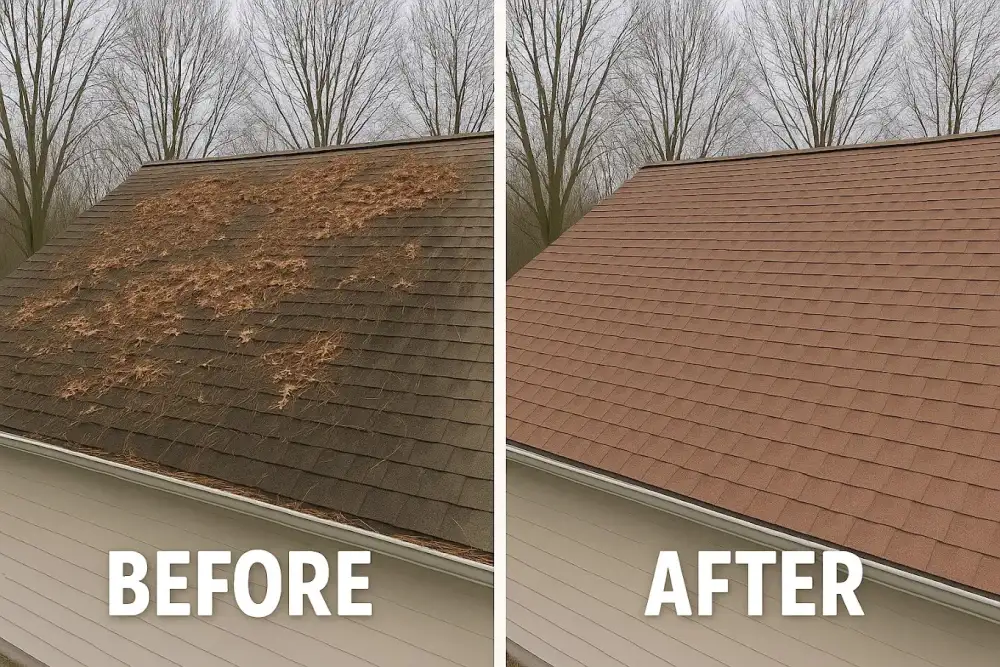
Short answer: Redmond roofs grow moss because the city hands moss its three requirements — moisture, shade, and organic debris — more generously than almost anywhere in the country. Our long wet season keeps roofs damp from October to May, mature evergreens shade entire neighborhoods, and needle drop feeds the process. The fix is regular, gentle cleaning — and never a pressure washer.
The Redmond moss recipe
We're based in Redmond, and after 17+ years on its roofs the pattern is completely predictable. Education Hill and English Hill: tall firs, shaded rooflines, moss on the north slopes. Bear Creek and the plateau edges: heavy canopy, needle-loaded gutters. Even newer construction around Redmond Ridge grows moss within a few years once the landscaping matures.
Moss doesn't need soil — it anchors directly to shingle granules. On a roof that stays damp for eight months a year, a few spores become a colony fast, and every needle and leaf that lodges in a valley holds extra moisture to accelerate it.
What it's doing to your shingles
Moss is not a cosmetic issue. Its rhizoids (root-like structures) work under shingle edges and physically lift them — turning a sealed roof surface into thousands of small water entry points. The moss mat itself acts as a sponge against the roof. Downstream, moss debris sheds into gutters and blocks drainage, which is one of the most common causes of fascia rot we find in Redmond homes.
The right removal method (and the wrong one)
The wrong one first: pressure washing. It visibly cleans the roof — by stripping away the granule layer that protects shingles from UV and weather. You trade a moss problem for years of lost roof life.
Done properly, moss removal is gentle: soft brushing and low-pressure application clear the growth, a moss-specific treatment kills what remains at the root, and the gutters and valleys are cleared of debris so drainage works again. Prevention is equally practical — trim overhanging branches for sunlight, keep gutters clear, re-treat every 1–2 years.
A Redmond-specific tip
If you're replacing a roof in a shaded Redmond neighborhood, choose algae-resistant shingles — modern lines embed copper-infused granules that suppress growth for years — or consider metal, which gives moss nothing to grip. We're happy to walk you through both options with a free estimate: (425) 270-1525.