
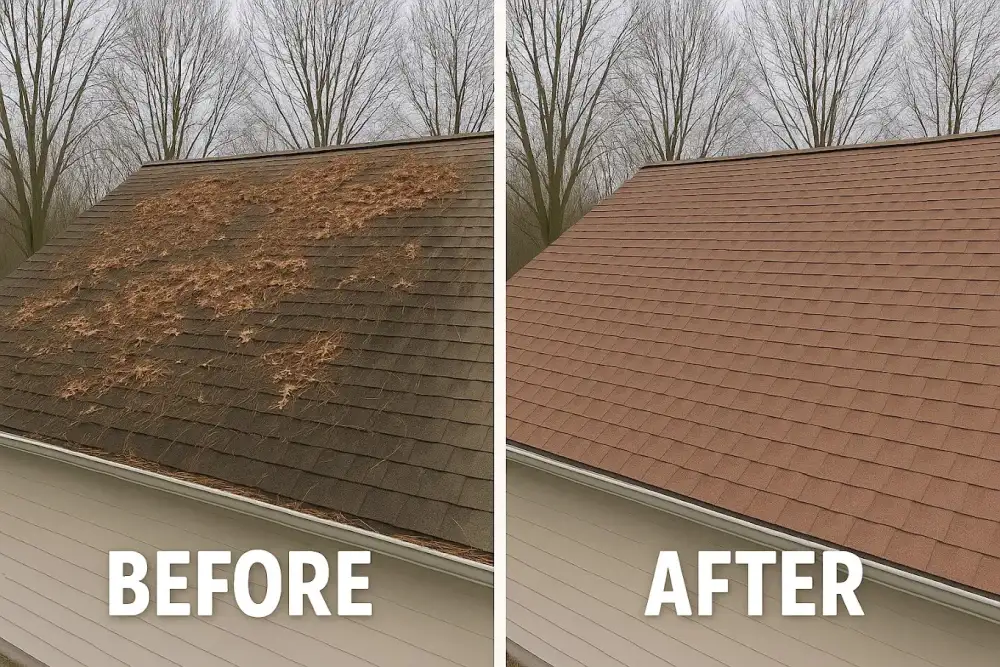
Short answer: tree canopy doesn't have to shorten a roof's life — unmanaged tree canopy does. Woodinville roofs under firs and cedars need a simple, consistent playbook: keep debris off, keep gutters clear, treat moss before it establishes, and trim strategically. Do that, and the trees and the roof coexist for decades.
What the canopy actually does
In our Woodinville work — Hollywood Hill, Wellington, the Sammamish Valley edges, Cottage Lake — the damage pattern under heavy tree cover is remarkably consistent:
- Needle load. Fir and cedar needles mat in valleys and against chimneys, holding moisture on the shingles and redirecting water sideways instead of down.
- Shade moisture. Canopy-shaded roofs dry slowly, and a roof that stays damp grows moss — whose root structures lift shingle edges and open water paths.
- Gutter failure. Debris-filled gutters overflow backward, under the roof edge, quietly rotting fascia boards until a soft spot or interior stain announces the problem.
The playbook
Fall, every year: gutters and downspouts cleared after leaf-drop; valleys and roof surface cleared of debris. This is the highest-value hour a canopy roof gets.
Every 1–2 years: professional roof cleaning with moss treatment — gentle methods that kill growth at the root without stripping shingle granules. Never pressure washing.
As needed: selective trimming. You don't need to clear-cut; removing the branches that directly overhang or shade the roof delivers most of the benefit — more drying sunlight, less needle load, and fewer limbs to drop in windstorms.
Annually: an inspection (ours are free and photo-documented). Under canopy, small problems hide well.
If you're replacing anyway
Heavy tree cover is the strongest argument for metal roofing in our region — needles slide off, moss finds no grip, and the maintenance burden drops dramatically. Among composition options, algae-resistant architectural shingles are the clear pick. We'll lay out both honestly with a free estimate: (425) 270-1525.