
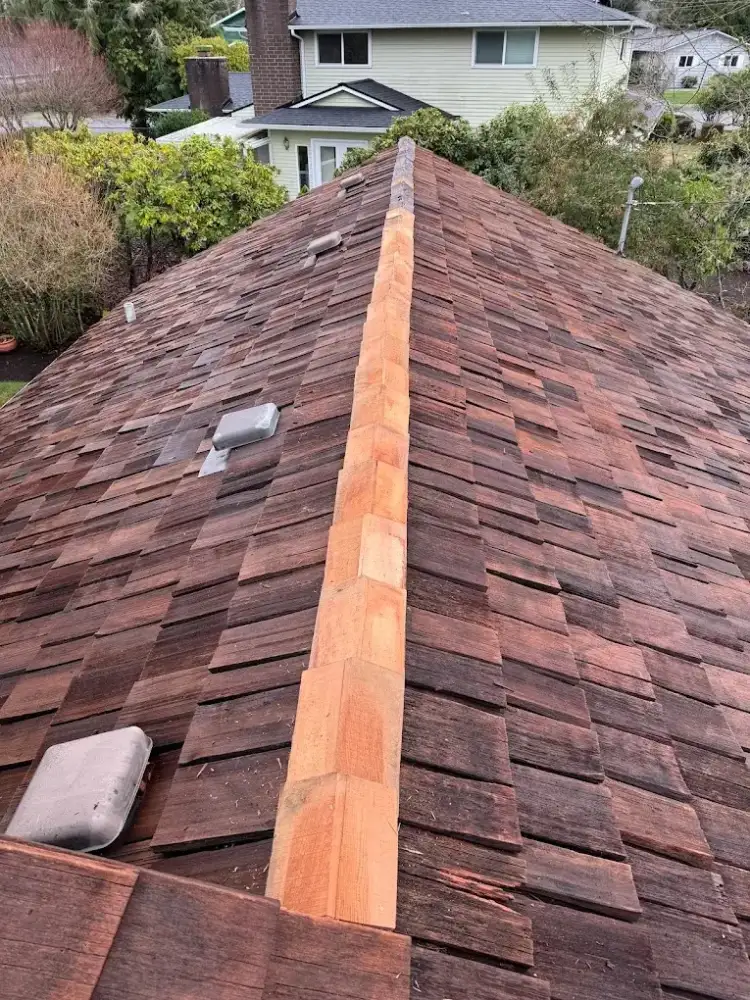
Short answer: cedar is the region's most maintenance-sensitive roof — a living material in a climate that never quite dries. The owners who get 40 years from shakes aren't lucky; they're on a schedule. Here it is.
Every fall: clear it
Needles and leaves matting between shakes are cedar's slow poison, holding moisture against wood that needs to breathe. Fall clearing — roof surface, keyways, valleys, and the gutters below — is the non-negotiable, and under the canopies of Bridle Trails or Sahalee, a spring pass too.
Every 1–2 years: moss, gently
Moss on cedar does what it does on composition, faster — wedging shakes apart and holding water in the wood. Treatment is soft: brushing with the grain, moss-specific products, never pressure. (Pressure washing cedar is roof destruction with extra steps; our DIY guide covers why.)
As they appear: the small repairs
Split, cupped, or slipped shakes are individual replacements when caught early — an afternoon's work that keeps the field sealed. Deferred, each one funnels water to the felt and skip sheathing beneath, and the repair grows roots. Ridge caps and flashings age faster than the field; watch them.
Every few years: the professional read
Cedar hides its condition from the driveway. A periodic walk-and-document inspection catches the drift — which fields are thinning, whether treatment is due, when the honest conversation shifts from maintenance to the restore-or-convert decision. That conversation has a right time, and it's before the wet season that forces it.
Cedar overhead? We repair, restore, maintain, and — when the wood says so — convert. Straight answers with photos, free: (425) 270-1525.