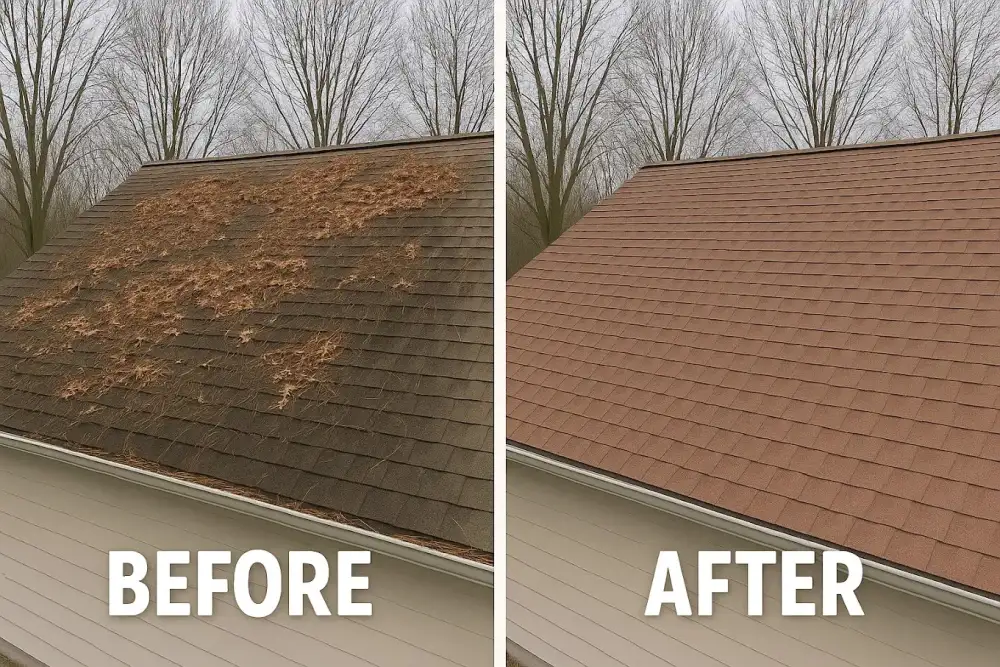
Professional soft wash or low-pressure treatment
A professional low-pressure treatment uses chemistry instead of force. The crew applies a moss-killing solution at low pressure, lets it work on the moss, algae and lichen at the root, rinses gently, and then clears what comes loose out of the valleys and gutters. Nothing is blasted, so the granules that protect your shingles from sun and weather stay where they belong.
The honest limits: thick, spongy mats usually need to be brushed off first, and some dead growth can take a few rain cycles to release completely. A good roof cleaner will tell you that up front rather than promise an instant showroom finish on a roof that has been growing moss for years.
What separates a careful job from a sloppy one
- Protecting what's below. Plants, decks, ponds and pools should be covered or rinsed, and downspouts managed so runoff doesn't pool where it shouldn't.
- Gutters cleared at the end, not the start. Moss debris lands in the gutters during cleaning, so clearing them last is what keeps drainage working.
- A walkthrough or photos. You should be able to see the result without climbing a ladder.
Cleanup is what homeowners remember. After a roof and gutter cleaning in Redmond, Peng Jin wrote that with a backyard swimming pool below, "not a single piece of debris or moss fell into the water" (read the full review).
Verdict: the right default for established moss on an asphalt shingle roof, especially when you can't, or shouldn't, be on the roof yourself.
Hand brushing plus treatment
Hand removal is exactly what it sounds like: someone on the roof works the moss loose with a soft-bristle brush or a plastic tool, always brushing down the slope with the shingle laps, never up under them. Then the roots that stay behind get a moss-specific treatment so the roof doesn't green over again by next spring.
Done well, this is the fastest way to a visibly clean roof, and it's often the first half of a professional job when the mats are thick. Done badly, it's how shingles get hurt. Metal scrapers, wire brushes and putty knives tear the edges that moss had only lifted, and brushing against the grain pries shingles up. Skip the treatment step and you've only given the roots a haircut.
Can you do it yourself?
On a low, walkable, single-story roof with dry footing and a stable ladder, some homeowners can, carefully. Wet shingles covered in moss are slick, and that's before you add a steep pitch or a second story. Our DIY vs. professional moss removal guide draws that line in more detail.
When a pro does it, the part you notice is the finish. Melissa Mohamed wrote that Vanderlei "did a super job getting rid of the moss, and cleaned up afterwards" (her review). That last clause matters. Brushed-off moss has to go somewhere, and it shouldn't be your gutters, walkways or flower beds.
Verdict: the right tool for heavy mats, and a reasonable DIY job only on roofs you can stand on safely.
Pressure washing
Pressure washing is the method people reach for because it works instantly. Point the wand and the moss is gone. That's the trap. On asphalt shingles, the same force that removes moss also strips the mineral granules that shield the asphalt from UV and weather. Granules don't grow back, so every pass trades a cosmetic win for real roof life.
It causes other problems, too:
- Water forced uphill. A high-pressure stream aimed at the wrong angle drives water under the shingle laps, where it was never meant to go.
- Lifted and broken tabs. Shingles that moss already loosened can tear or blow off later.
- Fast regrowth. Pressure knocks off what you can see and leaves roots in the joints, so the green comes back quickly.
- A slick, dangerous work surface for whoever is holding the wand.
Cedar and metal roofs aren't good candidates either. High pressure can fuzz and gouge wood fibers, and it can push water into seams and laps on metal.
To be fair to the method, pressure washing does excellent work where it belongs: concrete driveways, walkways and patios, where moss and algae make surfaces slippery and the material can take the force. That's the job our pressure washing service is for, and our soft washing vs. pressure washing guide explains which surfaces get which approach.
Verdict: rule it out for shingle roofs. Use it on the concrete below them.
Zinc or copper strips
Zinc and copper strips are installed near the ridge. When rain runs over them, it picks up a small amount of metal and carries it down the roof, which makes the surface below less hospitable to moss and algae. It's the same idea behind algae-resistant shingles, which use copper in their granules.
What strips do well: slow down new growth after a roof has been cleaned, with no ongoing effort from you. What they don't do: remove moss that's already rooted. A thick mat will sit happily under a brand-new strip for a long time.
A few practical limits worth knowing before you buy:
- Coverage follows the water. Protection is strongest in the band directly below the strip and weakens farther down the slope. Areas below dormers, chimneys, skylights and valleys may get little runoff from the strip at all.
- Installation matters. Strips are usually fastened under a shingle course near the ridge. Exposed nails that aren't sealed are new leak points.
- Copper vs. zinc. Copper is generally the more potent of the two and costs more. Both weather and lose some effect over time.
- Runoff goes somewhere. If your downspouts drain toward a creek, pond or rain garden, metal runoff is worth thinking about. Check your local stormwater guidance.
Verdict: a sensible add-on after a professional cleaning, especially on simple roofs with long, uninterrupted slopes. Not a removal method.
DIY spray treatments
Store-bought moss treatments come in two broad types. Fast-acting products kill moss quickly; it turns brown or orange and still has to be brushed or rinsed off. Slow-acting "spray and leave" products kill the moss and let wind and rain carry the dead growth away over the following months. Both can work on light growth when you follow the label.
Where DIY spraying goes wrong:
- Using the wrong product. Household bleach is not a moss treatment. It can burn landscaping, discolor surfaces and corrode metal gutters and flashing.
- Spot coverage. Spraying only the green patches leaves spores in the surrounding areas untouched, so the next patch is already on its way.
- Ladder work with a sprayer in hand. A hose-end sprayer used from the ground is the safest version. Carrying a tank up a ladder is not.
- Ignoring the plants below. Wet down landscaping before and after, and skip windy days.
Timing matters, too. Most treatments need dry weather to soak in, so apply them when no rain is forecast for a while, and follow the label's directions on how much to use and how often.
The upside is real, though. For a homeowner who catches moss early, keeps gutters clear and treats on a regular schedule, a DIY spray can stretch the time between professional cleanings. It's a maintenance tool, not a rescue for a roof that's already carpeted.
Verdict: good for first-stage fuzz on an easy-access roof. Not enough for established moss, and not worth a fall.
Doing nothing
Doing nothing costs nothing this month, which is why so many Puget Sound roofs are wearing green. The bill comes later. Moss doesn't just sit on top of shingles. It roots under their edges, lifts them, and holds water against the roof long after the rain stops. Debris sheds into the gutters, downspouts clog, and overflowing water starts working on fascia boards and the roof edge.
The damage is slow, which makes it easy to ignore. A roof that would have been a cleaning-and-treatment job a few winters ago can turn into a repair job, with lifted shingles and soft decking at the eaves. Our guide to moss on your roof walks through what's happening under the mat.
There is one honest case for waiting. If your roof is at the end of its life and a replacement is already planned, spending on a full cleaning may not make sense. Put that money toward the new roof, keep the gutters flowing in the meantime, and have someone confirm the timing with an inspection rather than guessing. And a few specks of moss on a sunny slope aren't an emergency; watch them, and plan a treatment before they spread.
Verdict: only defensible as a short pause before a planned replacement or cleaning. As a long-term plan, it's the most expensive option on this page.
How to choose the right moss removal method
Work through these questions in order and the answer usually picks itself.
- What is the roof made of? On asphalt shingles, rule out pressure washing. Cedar and metal need gentle, material-specific cleaning, too.
- How much moss is there? Light fuzz responds to treatment alone. Thick mats need careful hand removal first, then treatment.
- Can you safely reach it? A low single-story roof with dry footing is one thing. A steep pitch, a second story or a wet roof is a professional job.
- What's underneath? Pools, ponds, gardens and decks change how the work should be done, and who should do it.
- How will you keep it off? Trim overhanging branches for more sun, keep gutters clear, and consider strips or periodic treatment.
A note on cedar and metal roofs
Everything above assumes asphalt shingles. Cedar roofs grow moss and lichen even more readily, and they need gentle cleaning that won't shred the wood, plus attention to split shakes while someone is up there. Metal roofs grow far less moss, but needles, pollen and debris still collect in valleys and gutters and need clearing. On every material, the same rules hold: low pressure, the right product, and gutters cleared at the end.
If you'd like a second set of eyes, First Choice Roof Service is based in Redmond and has worked on roofs across the Greater Puget Sound for 17+ years. Google's topic chips for our 238 reviews list roof cleaning in 59 of them and moss removal in 12. Inspections are free and photo-documented, so you can see the roof's condition before you decide anything. Learn more about our roof cleaning and moss removal service, or call (425) 270-1525 to schedule.