
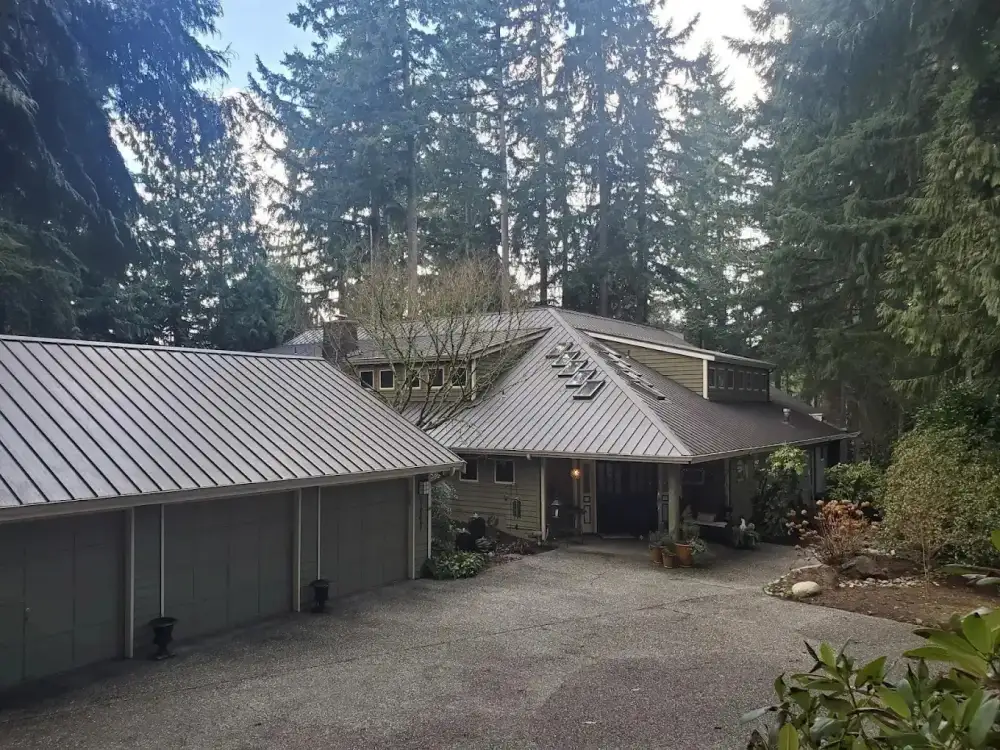
Short answer: clean a metal roof gently and from the top down. Clear needles, branches and debris with a blower or soft brush, open up the valleys and gutters, then wash with plain water, or a mild detergent if water isn't enough, using a soft brush and a low-pressure rinse. Rinse thoroughly. Never use wire brushes, abrasive pads, scouring powder or acetone on a painted metal roof, never blast seams and fasteners with high pressure, and follow your panel manufacturer's care instructions before anyone else's. If the roof is steep, high, wet or complicated, it's a job for someone with fall protection.
Metal roofs have a reputation in the Pacific Northwest as the roof you never have to think about. Moss has a hard time rooting in a smooth painted panel, and rain slides right off. But low-maintenance isn't no-maintenance. Under our evergreens, a metal roof still collects needles, cones, branches and a spring coating of pollen, and that debris holds moisture against the finish, dams up valleys and fills gutters.
A real example: a big roof, fir needles and years of pollen
Mark Swearingen's review describes the problem well. His metal roof was "covered with fir needles and branches from recent wind storms and also coated with pollen from the last couple years". He called it "a big, complex roof", and after the cleaning wrote that "it looks like new now!" He also noted that they did "a great job of cleaning up all the debris that came off the roof", a reminder that everything that comes off a roof has to land somewhere. You can read the full metal roof and gutter review.
The rest of this guide covers how to approach a roof like that one: what to clear, what to wash with, what to avoid, and when to hand it off.
Know what kind of metal roof you have
The term metal roof covers several different systems, and the right care depends on which one is on your house. Before you clean anything, find your paperwork or ask the installer.
- Standing seam. Panels joined by raised seams, with the fasteners hidden underneath. Common on newer Northwest homes. The seams and the clips below them are the sensitive parts.
- Exposed-fastener panels. Corrugated or ribbed panels screwed through the face, with a rubber washer under each screw head. Those screws and washers are what you watch.
- Metal shingles and stone-coated steel. Stamped metal that imitates shingles, shake or tile. Stone-coated products carry a granule surface that should be treated as gently as an asphalt shingle.
- Bare or natural-finish metal. Galvalume, copper and zinc have no paint layer and age on their own terms. Their manufacturers publish their own care rules, and those rules come first.
Many residential metal roofs are factory-painted steel or aluminum, often with a PVDF finish (sold under names like Kynar 500 and Hylar 5000) or a silicone-modified polyester finish. These coatings are tough, but they're a thin film, and nearly everything on the list of things never to use, below, exists to protect that film. If you're still deciding whether metal suits your home, our metal roofing page covers the options.
Step 1: Clear the debris
Start dry. Washing a roof that's still covered in needles just turns them into paste.
- Blow or brush, don't scrape. A leaf blower clears loose needles and pollen dust quickly. For packed debris, use a soft-bristle broom or brush. Never use a metal shovel, scraper or putty knife on the panels.
- Lift branches, don't drag them. Dragging a branch across a painted panel can scratch the finish down to bare metal, and a scratch on steel is where rust starts.
- Work with the panels. Move debris downhill along the ribs toward the gutters, not sideways across seams.
- Check the hiding spots. Needles collect on the uphill side of chimneys, skylights, vent pipes and dormers, along the base of the ribs and at panel overlaps. Those small dams hold water against the metal long after the rest of the roof has dried.
After a big windstorm, look for anything heavier than needles. Falling limbs can dent panels or knock trim loose. Our guide to Puget Sound windstorm season covers what to check after a blow.
Step 2: Open the valleys and gutters
Valleys, the channels where two roof planes meet, carry more water than any other part of the roof, and a big, complex roof may have several. When fir needles pile up in a valley, water backs up behind them and can work its way under trim and flashing that were never meant to hold standing water. Clear valleys completely, from the top down.
Then the gutters. Metal roofs shed debris quickly, which is good for the roof and hard on the gutters: one windy week can pack them full. Clear them by hand or with a scoop, flush each downspout with a hose, and confirm water exits at the bottom. If your gutters fill faster than you can keep up, scheduled gutter cleaning is usually less work than fighting overflow in January.
Step 3: Wash the painted finish, gently
With the debris gone, many metal roofs need nothing more than a rinse. Washing removes the pollen film and the grime that gives mildew and algae something to feed on.
- Start with plain water. A garden hose or a low-pressure rinse is often enough.
- Step up to a mild detergent only if needed. Use a gentle, non-abrasive household detergent diluted in water, applied with a soft cloth, sponge or very soft brush.
- Test first. Try any cleaner on a small, out-of-sight area before using it across the roof.
- Work top to bottom, in sections. Wash a manageable area and rinse it before the solution dries. Cleaner that dries on a warm panel can leave streaks and residue.
- Rinse thoroughly. Every trace of cleaner should come off. Residue left on the finish attracts dirt and can harm the coating over time.
Those steps line up with the Metal Construction Association's Technical Bulletin 1050, Metal Roof Coating Maintenance, a long-standing industry guide to cleaning painted metal. The bulletin recommends testing any cleaning method on a small, inconspicuous area first, washing from the top of the panels down, and rinsing thoroughly with clear water, because residue left behind may damage the paint film. It describes an annual washing as the regular maintenance factory-painted panels need.
What never to use on a metal roof
This is the list that saves finishes. The MCA bulletin is specific on several of these points for PVDF and plastisol coatings, and the rest is common sense for any painted surface.
- Wire brushes, steel wool, abrasive pads and scouring powder. The bulletin says not to use wire brushes, abrasives or similar tools that mechanically abrade the coating. Scratches dull the finish and expose metal.
- Acetone. The bulletin states plainly that acetone should not be used on PVDF and plastisol surfaces. That includes cleaners that contain it.
- Strong solvents, lacquer thinner and paint remover. The bulletin treats these as spot-cleaning tools for things like tar or sealant, to be tested first and left on only briefly. They don't belong in a roof-wide wash.
- Mixed cleaners. Never combine products. The bulletin warns that cleaners containing ammonia mixed with bleach can produce harmful vapors, and a roof is the worst place to be caught breathing them.
- Acids and rust removers. Muriatic and oxalic acid are corrosive. Keep them off the roof unless your manufacturer specifically calls for them.
- Undiluted bleach. For stubborn mildew, some care guides allow a dilute bleach solution followed by a thorough rinse. Check your manufacturer's instructions first, protect the plants below, and never mix it with ammonia.
- High-pressure washing up close. More on that below.
- Anything your panel or paint manufacturer doesn't approve. Off-label cleaning can affect a finish warranty. When the manufacturer's care sheet and general advice disagree, follow the manufacturer.
Fasteners, seams and trim: what to look at while you're up there
Cleaning day is your easiest chance to look closely at the parts of a metal roof that actually keep water out.
- Exposed fasteners. Look for screws that have backed out, missing screws, and rubber washers that look cracked, flattened or brittle. Rust streaks below a screw head are a clue. Don't fix them by cranking screws tighter; over-tightening crushes the washer and makes a leak more likely, not less.
- Standing seams. Check that the seams are closed and undamaged. Don't walk on them or pry at them.
- Sealant and trim. Ridge caps, eave and rake trim, and the flashing around chimneys, skylights and vent pipes rely on sealants and closures that age. Gaps, cracks or loose trim are worth a professional look.
- Scratches and chips. Small scratches can be touched up, but use the manufacturer's matching touch-up paint, not generic spray paint, which weathers differently.
- Loose metal bits. Steel shavings, stray screws or old nails left on a painted roof can leave rust stains. Sweep them off. And ask before adding copper or zinc moss-control strips, because some metal combinations don't get along.
If you find something that worries you, a photo-documented roof inspection will tell you whether it's a quick fix or a sign of something bigger.
Why pressure washing is risky on metal
Metal is hard, so it's tempting to assume it can take a pressure washer. The panel can. The details often can't. A narrow, high-pressure stream aimed at the roof can:
- drive water uphill past panel overlaps, under ridge caps and behind flashing, where it was never designed to go;
- force water under fastener washers and loosen aging sealant;
- erode or etch the paint if the nozzle gets too close, especially on older, chalky finishes;
- strip the granules from stone-coated steel; and
- throw you off balance. Recoil from a wand on a slick roof is a fall waiting to happen.
Low pressure and plenty of water do the work instead. The MCA bulletin itself lists a low-pressure spray washer as an acceptable washing tool. Keep the spray wide, keep your distance, and always spray downhill, the same direction rain flows.
Moss, lichen and algae on metal
Metal resists moss far better than shingles do, but it isn't immune in deep shade. Growth usually starts where debris collects, behind chimneys, along the bottom of the ribs and in valleys, because that's where there's something to root in and moisture to feed it. Clear the debris and much of the problem goes with it. For the film that remains, a manufacturer-approved cleaner and a soft brush are the right tools. Lichen is stubborn and tempting to scrape. Don't. Repeated gentle cleanings beat one aggressive one that damages the coating.
Staying safe on slick panels
A metal roof is one of the most slippery surfaces a homeowner can stand on. Wet panels, morning dew, a film of pollen or a scatter of needles can turn a moderate pitch into a slide. Before anyone goes up:
- Work only when the roof is completely dry. In fall, a roof that looks dry at noon may still be damp in the shade.
- Use fall protection. A harness tied to a proper anchor is standard practice for professionals, for good reason.
- Set the ladder properly. Secure it, extend it above the eave, and keep its weight off gutters that can't take the load.
- Know where to step. On exposed-fastener panels, step in the flats near the fastener lines, where the panel is supported underneath; stepping mid-span or on the ribs can dent it. On standing seam, stay off the seams, and on steep pitches, don't walk at all.
- Never work alone, and stay well clear of the power line to the house.
- Do what you can from the ground or the ladder. Long-handled soft brushes and a hose worked from the eave can handle a lot of the roof without anyone standing on it.
How often to clean a metal roof in the Pacific Northwest
For a metal roof under evergreens, a sensible rhythm is a debris check and gutter clearing in fall and again in spring, a gentle wash about once a year, and a look after any major windstorm. A roof in the open with no trees nearby may need far less. The MCA bulletin's annual washing is a good default for painted panels. Your own trees decide how much more you need.
When to call a professional
Hand the job off when any of these are true:
- The roof is big, complex or more than one story, the kind Mark described.
- The pitch is steep enough that you'd need to be tied off to work safely.
- Debris is heavy: branches, packed valleys, gutters full to the brim.
- You aren't sure what finish is on your roof or which cleaners it can take.
- You've spotted loose fasteners, open seams or damaged trim.
- It's the wet season and the roof never fully dries.
When you hire, ask the questions you'd ask yourself: what method and cleaner will be used, whether the finish has been identified, how debris will be kept off the ground and out of the gutters, and whether gutter cleaning is included. A good roof cleaner will also tell you when something on the roof needs repair rather than cleaning.
If you're still deciding between metal and shingles for a future roof, our comparison of metal roof vs. shingles costs in Washington walks through the long-term math.
First Choice Roof Service cleans and maintains metal, shingle and cedar roofs and gutters across the Greater Puget Sound area. For a free written estimate, use the contact page or call (425) 270-1525.