“It was covered with fir needles and branches from recent wind storms and also coated with pollen from the last couple years.”
— Mark Swearingen
A big, complex roof under tall evergreens
Mark Swearingen posted his five-star review in February 2022, and he described the job plainly: First Choice “did a fantastic job of cleaning my metal roof and gutters.”
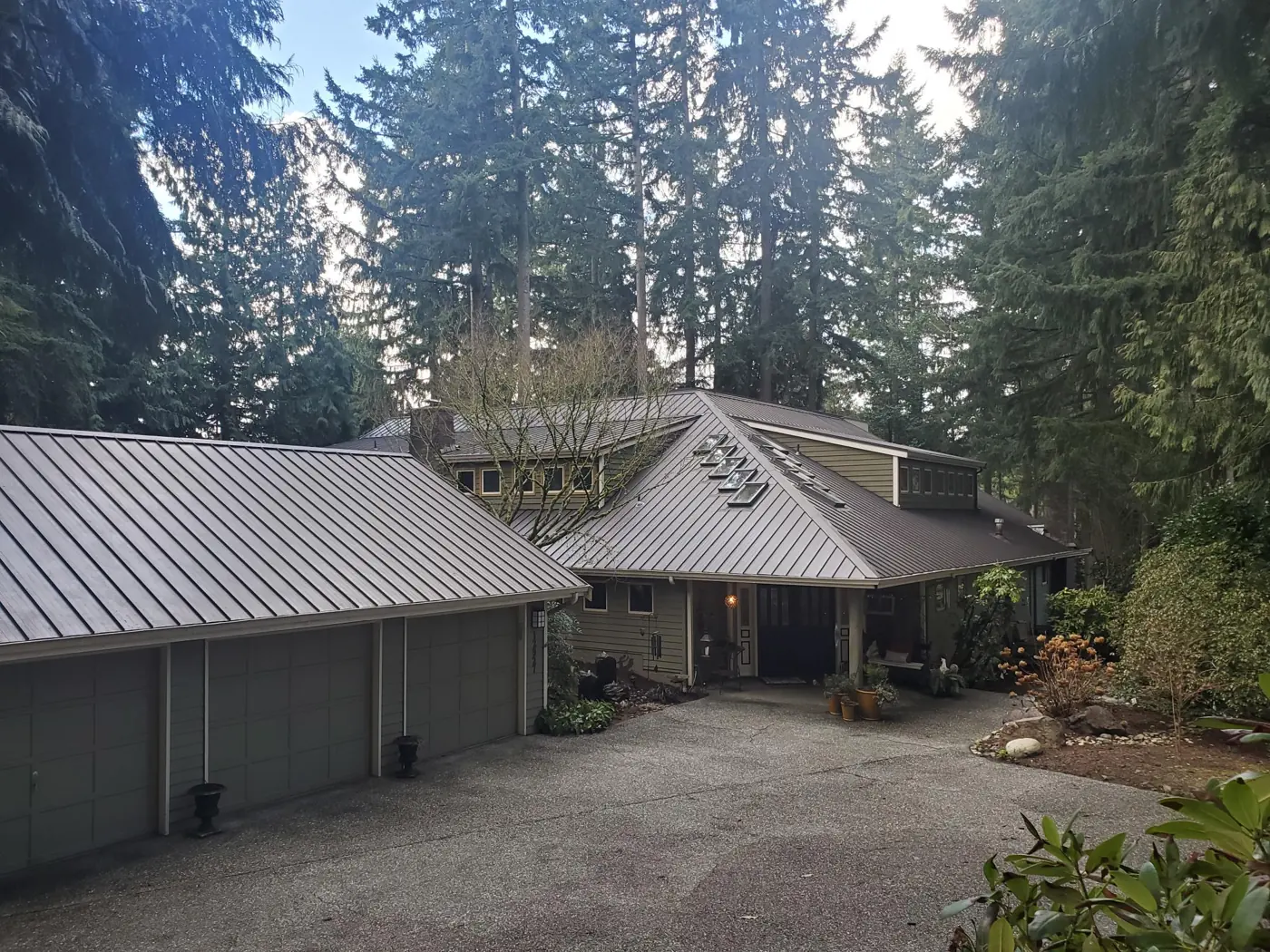
This was not a simple roof. In Mark's words: “It's a big, complex roof and it looks like new now!” His photo shows why. The house has a gray standing-seam metal roof spread over several wings, with a run of skylights, a detached garage and a stand of tall evergreens rising behind it.
Before the cleaning, he wrote, the roof “was covered with fir needles and branches from recent wind storms and also coated with pollen from the last couple years.” For a home surrounded by tall firs, that is a familiar picture after a run of windstorms. He finished by praising the crew for “cleaning up all the debris that came off the roof.”
Plenty of Puget Sound homes sit under the same kind of trees, so the lessons from Mark's roof apply well beyond his property.
Why needles, branches and pollen matter on a metal roof
Metal roofs shed rain quickly, which leads some owners to assume they look after themselves. Mostly they do, but debris still builds up in predictable places:
- Valleys, where two roof planes meet and needles pack into a mat.
- The uphill side of skylights and chimneys, where anything sliding down the roof stops.
- Gutters and downspouts, which catch everything the roof sheds.
A mat of wet needles holds moisture against the metal long after the rain stops. Over time that can wear on the paint finish and encourage staining, algae and corrosion around fasteners and panel edges. Pollen on its own is mostly a cosmetic film, but mixed with needles and rain it builds the kind of organic layer that holds water and feeds growth. Branches add another risk: a heavy limb can dent a panel or knock trim out of line.
None of this happens overnight. That is why a periodic cleaning, especially after windstorm season, is a small job that protects a large investment.
Cleaning a metal roof without damaging it
Cleaning a metal roof is a different job from cleaning a shingle roof. A few things any crew should get right:
- Gentle tools. Soft brushes, blowers and low-pressure rinsing. Wire brushes, scrapers and abrasive pads can scratch the coating that protects the metal.
- The right cleaning products. Harsh or abrasive cleaners can dull or damage the finish. Ask what will be used and whether it is safe for coated metal roofing.
- Careful footing. Metal is slippery, especially when it is wet or dusted with pollen. On standing-seam roofs, crews should step in the flat pans, not on the raised seams.
- Skylights and trim. Debris packed against skylights and flashing needs to be cleared by hand.
- Exposed fasteners and sealant. Where a roof has exposed screws, such as on trim and flashing, a cleaning visit is a good time to look for loose screws, worn washers and cracked sealant, and to ask for photos of anything that needs attention.
Our guide on how to clean a metal roof in the Pacific Northwest goes into more detail, and the metal roofing page covers this roof type more broadly.
Gutters take the hit after a windstorm
Everything Mark described, the needles, the branches and the pollen, eventually ends up in the gutters. Once they fill, water spills over the edge instead of reaching the downspouts, which can stain siding, soak the ground near the foundation and rot fascia boards over time.
On a home under tall firs, a sensible rhythm is to check the gutters after each major windstorm and clean them before the heavy fall rains. If you see water sheeting over the gutter edge during a storm, they are already overdue.
The last thing Mark mentioned is cleanup on the ground. On a large roof, a lot comes down: needles, cones, branches and the sludge pulled out of the gutters. Ask any cleaning crew how they will collect it and what they will leave behind. First Choice offers gutter cleaning alongside roof cleaning, and on a home like this, doing both in one visit means the gutters are cleared after the roof debris comes down rather than before.