
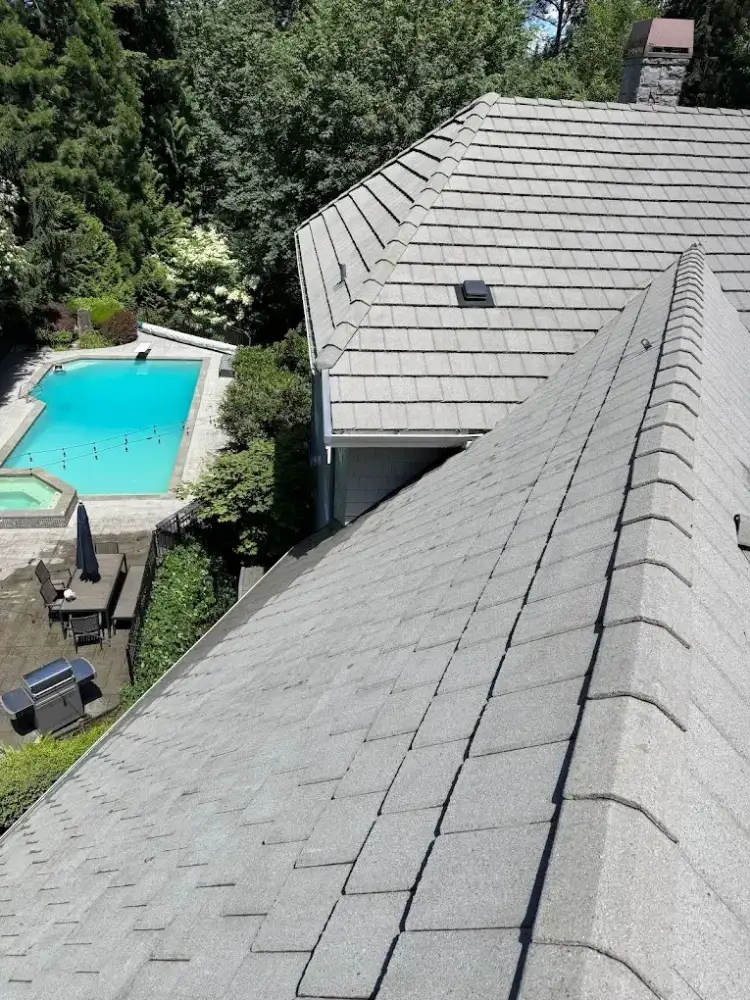
Short answer: "keep an eye on it" means your roof isn't failing today, but something on it deserves watching: an aging flashing, a stain whose source isn't clear, a section that's wearing faster than the rest. It's a legitimate inspection result, not a brush-off. Your job is to check a short list of places on a schedule, take photos so you can spot change, and call back if anything moves. Here's how to do that without ever climbing onto the roof.
A real example: honest advice instead of a sales pitch
Joyce Chen had her roof looked at by Sean from First Choice. In her review she wrote that he "thoroughly inspected my roof and gave me honest advice that no repair is needed at this time—just keep an eye on it." The company's reply refers to her "potential leak" and asks her to "keep me updated" so they can figure out what's going on. The one photo posted with her review shows a metal vent pipe and its flashing sitting between two skylights on a composition shingle roof, which is exactly the kind of roof penetration this guide tells you to watch.
That's a pattern worth understanding. When a roof has a possible problem that isn't confirmed, like an occasional drip or a stain that might be old, the honest move is often to watch and gather evidence rather than replace parts on a guess. You can read Joyce's full review.
Why "no repair needed" is a legitimate outcome
An inspection is a diagnosis, not a sales appointment. Plenty of roofs come back with a clean or mostly clean report, and that's useful information: it tells you where the roof stands, sets a baseline, and keeps you from paying for work you don't need.
"Keep an eye on it" usually means one of a few things:
- The roof is aging normally. Some granule wear and a few weathered spots, but nothing that lets water in yet.
- There's a possible leak with no clear source. Leaks can be intermittent, showing up only in wind-driven rain or after days of steady soaking. Chasing one that isn't active can mean replacing the wrong part.
- A component is near the end of its life but still working. A rubber pipe boot, a sealant joint, an older skylight. Replacing it now isn't wrong, but it isn't urgent either.
- Something next to the roof needs watching. Overhanging branches, gutters that fill fast, or attic ventilation that could be better.
If an inspector tells you to keep an eye on something, ask them to name it: which spot, what change would matter, and roughly when to check again. A good inspector will be specific, and a good roof inspection comes with photos so you can see what they saw.
Questions to ask before the inspector leaves
"Keep an eye on it" is only useful if you know what "it" is. Before the inspector heads to the next job, get clear answers to these:
- What exactly should I watch, and where is it? Ask them to point it out from the ground or in a photo so you can find it again.
- What would getting worse look like? A bigger stain, a lifted edge, granules collecting in one gutter? Knowing the warning sign is what makes watching possible.
- How often should I check, and when should you come back? After the next big storm, before next winter, or at a set interval?
- Is there anything I can safely do in the meantime? Clearing a downspout or trimming a branch from the ground might take pressure off the problem spot.
- If this turns into a repair, what's likely involved? You're not committing to anything. You just want to know whether the eventual fix is small or large so you can plan for it.
- Can I have the photos? Keep them. They're the start of your baseline.
What to watch: the short list
None of this requires going on the roof. Use the ground, a pair of binoculars, a phone camera zoomed in, and the attic hatch. Leave anything above the gutter line to a professional.
Inside: the attic and ceilings
- Attic stains. With a flashlight, look at the underside of the roof deck and rafters, especially around anything that comes through the roof. Dark rings, water lines or damp insulation are the signs.
- Daylight. Turn the attic light off. Pinpoints of light around a pipe or vent mean a gap.
- Frost or condensation. In cold snaps, frost on nail tips or a damp deck across a wide area often points to ventilation or moisture from the house rather than a roof leak. Our post on attic ventilation problems in Washington explains the difference.
- Ceiling spots. Watch for new stains, bubbling paint, or a stain that grows after rain. Lightly trace the edge of an existing stain in pencil. If it spreads past the line, it's active.
Around skylights, flues and chimneys
Penetrations are common leak points, because that's where shingles have to be cut, flashed and sealed around something. Watch for:
- Drips or staining on a skylight shaft or the drywall around it. Fogging between the panes is a seal problem, not a roof leak, but worth noting. Our skylight leak guide covers how to tell condensation from a true leak.
- Rust, lifted edges or cracked rubber around vent pipes and flue collars.
- Gaps, crumbling mortar or loose counter-flashing at the chimney. Our chimney flashing guide shows what failing flashing looks like.
Outside: from the ground and the gutters
- Granules in gutters and at downspout outlets. Some shedding is normal, especially on newer shingles. A sudden heavy load, or bare dark patches on the roof, means wear is speeding up.
- Flashing. Bent, lifted or rusted metal along walls, in valleys and at the roof edge.
- Shingles. Missing, cracked, curled or lifted tabs, and any that have slipped out of line.
- Moss and debris. Moss lifting shingle edges and needles packed into valleys both hold water against the roof.
- Sagging lines. A ridge or roof plane that dips can mean a decking or structural problem. That's a call-now sign, not a watch item.
After windstorms
Puget Sound windstorms are when "keep an eye on it" turns into "check today." After a big blow, walk the property and look for shingle pieces in the yard, lifted tabs along the ridge and roof edges, branches resting on the roof and bent flashing. Then check the attic and ceilings the next time it rains hard.
A seasonal routine for Western Washington
Roofs here contend with a long wet season, heavy tree cover and the occasional windstorm, so a good routine is built around getting ready for the rain and checking after storms.
- Late summer into early fall, before the rains: Clean the gutters and downspouts, clear needles out of valleys you can reach safely, trim branches that touch the roof, take your baseline photos, and look at the attic while it's dry so you know what normal looks like.
- After the first heavy rain of the season: Check the attic and ceilings, especially around skylights, flues and the chimney. This is the roof's first real test of the year.
- Through winter, and after every windstorm: Walk the property, look up at ridges and edges, scan the yard for shingle pieces, and recheck any stain you've traced.
- Spring: Clean the gutters again, look for moss on shaded slopes, and compare the roof against your fall photos.
- Every year or two: Book a professional inspection if your roof is older, has leaked before, or came with a "keep an eye on it" note.
Use photos as your baseline
Memory is a poor measuring tool. Photos are a good one. After an inspection, build a simple baseline:
- Ask for copies of the inspection photos. If the inspection was photo-documented, you already have a head start.
- Take your own from the same spots each time: each side of the house from the ground, the gutters, any ceiling stain (with a tape measure in the frame), and the attic around every penetration.
- Name files by date and location, such as "2026-11 north slope," and keep them in one folder.
- Compare them side by side each season. You're looking for change: a stain that grew, flashing that shifted, a slope that looks darker or barer than it did.
The same folder pays off later. If you ever file an insurance claim or sell the house, dated photos show the roof was watched and maintained, not ignored.
When to call back
Call your inspector back, without waiting for the next season, if you see:
- Any active drip, or a ceiling stain that spreads past your pencil line.
- Damp insulation, wet decking or daylight in the attic.
- Missing shingles or lifted flashing after a storm.
- A sudden jump in granules in the gutters.
- Sagging, soft-looking areas, or anything else that makes you uneasy.
When you call, have your photos ready and describe when the problem appears: every rain, only in wind-driven rain, or only after a long soak. That detail is what lets a roofer track down an intermittent leak instead of guessing. If water is coming in right now, our guide to signs of a roof leak and what to do covers the first steps.
When it makes sense to fix it anyway
Watching isn't always the right call, even when nothing is leaking yet. It can be reasonable to replace a small, inexpensive part early, such as a cracked pipe boot or a dried-out sealant joint, before the wet season instead of waiting for it to fail in the middle of winter. The same goes for a roof you can't check often: a rental, a vacation property, or a house that's about to sit empty for a while.
The test is simple. If the repair is small and the cost of a failure is high, fixing early can be the cheaper path. If the repair is large and the evidence is thin, watching and documenting usually makes more sense. Either way, it should be your decision, made with photos in front of you, not one made under pressure.
How to tell an honest inspector from an upsell
Most homeowners can't check a roofer's diagnosis themselves, so trust has to come from how the inspection is done. Signs you're dealing with an honest inspector:
- They actually look: on the roof where it's safe, and in the attic where it matters, rather than quoting from the driveway.
- They show you photos of what they found and explain them in plain language.
- They sort findings into "fix now," "fix soon" and "watch," and they're comfortable saying nothing is needed today.
- They put any recommendation in a written estimate and give you time to think.
- They can tell you what change would make them recommend a repair later.
The warning signs run the other way: pressure to sign the same day, a full replacement pitched for a roof with one small issue, damage you're never shown, or promises that insurance will cover everything. Our post on roofing scam red flags in Washington goes deeper.
A "no repair needed" visit isn't wasted time. It means you know where your roof stands, you have a baseline to measure against, and your money stays in your pocket until the roof actually needs it.
Want a second look or a baseline?
First Choice Roof Service offers free, photo-documented roof inspections across the Greater Puget Sound area. If you were told to keep an eye on something and you've noticed a change, or you'd simply like a starting point, request a free inspection or call (425) 270-1525.