Architectural asphalt shingles
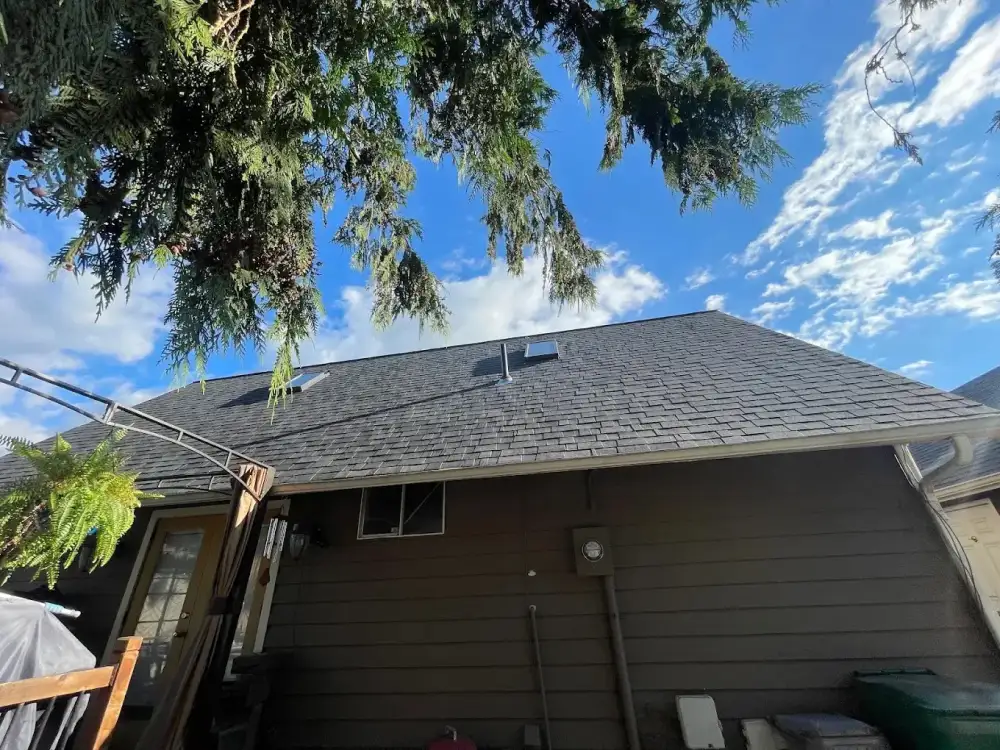
Architectural shingles, also called laminated or dimensional shingles, bond two or more layers together. That gives them a thicker profile and the shadowed, textured look you see on many newer roofs around the region. They're the default recommendation for a typical Puget Sound house for plain reasons: they keep water out well, they're widely repairable, matching colors are easy to find, and nearly every roofer knows how to install them properly.
We install shingle lines from Owens Corning, Malarkey, CertainTeed and IKO. Many architectural lines are available with algae-resistant granules, which help against the black streaking common on shaded slopes here. They don't make a roof moss-proof. Under evergreens, moss will still find a north-facing slope, and that's where shingle life is won or lost.
What shortens an architectural shingle roof here is rarely sunshine. It's moisture: moss rooting under edges, needles packing the valleys, gutters overflowing onto fascia. Keep those in check and the roof has a long life. Ignore them and it ages fast. On the practical side, most residential roof replacements we do take 1–3 days, so the disruption is short.
- Strengths: value, repairability, color choice and solid wind performance for the price.
- Weak spots: moss in shade, granule loss as the roof ages, and any pressure washing.
See our asphalt shingle roofing page for what a shingle roof replacement involves.
Verdict: the value pick for most homes, as long as someone keeps the moss and gutters in check.
3-tab asphalt shingles
3-tab shingles are the older, flatter style: a single layer cut into three tabs per strip, which gives that uniform, brick-like pattern. They're lighter and cheaper than architectural shingles, and that's most of the case for them.
The trade-offs show up in exactly the conditions we get. A single thin layer has less material to lose before it fails, and flat tabs are more prone to lifting and tearing in wind than heavier laminated shingles. Moss that roots under a thin tab edge pries it up sooner. Color and product choices are also often narrower than for architectural lines.
So when does 3-tab make sense?
- Outbuildings. A detached garage or shed where looks and longevity matter less.
- Short horizons. A property you're selling soon, with the trade-offs understood and disclosed.
- Matching repairs. Patching an existing 3-tab roof that isn't ready for replacement.
For a home you plan to live in, the step up to architectural usually costs modestly more and buys a thicker, better-looking, more wind-resistant roof. In a region where windstorms and moss are the main enemies, that's money well placed. If you're comparing bids and one comes in noticeably low, check which shingle style it actually specifies.
One caution if you're planning matching repairs: an older, weathered 3-tab roof can be hard to match exactly in color, so patched areas may stand out. That's cosmetic, but worth knowing before you plan a string of repairs on a roof near the end of its life.
Verdict: fine for outbuildings and short horizons. For your main house, architectural is the better spend.
Standing-seam metal
Standing-seam metal roofs use long panels that run from ridge to eave, joined at raised seams with the fasteners hidden underneath. That design is why metal does so well in this climate: there are no shingle edges for moss to root under, water and needles shed quickly, and the panels don't absorb moisture. It's also light, which helps on older framing.
The catch is the upfront cost, in the top tier on this page alongside cedar. Our metal vs. shingles cost breakdown runs through when the long life and lower upkeep earn that premium back. Short version: the longer you stay and the more trees you have, the better metal looks.
Low maintenance isn't no maintenance. Needles and branches still land in valleys and gutters. Mark Swearingen described his metal roof as "covered with fir needles and branches from recent wind storms and also coated with pollen from the last couple years." After the cleaning, he wrote: "It's a big, complex roof and it looks like new now!" (his review).
- Not the same as exposed-fastener panels. Ribbed or corrugated panels screwed through the face rely on rubber washers that age. Standing seam avoids that.
- Snow can slide. For the occasional snowy week, consider snow guards above entries and walkways.
- Rain noise is a common worry, but over solid decking with underlayment it's rarely an issue.
- Finish matters. Panel color comes from a factory-applied coating, so ask what finish the panels use and what the manufacturer's finish warranty covers.
More on the system on our metal roofing page.
Verdict: the long-haul pick for shaded lots and owners staying for decades.
Cedar shake
Cedar shake is the classic Northwest roof: thick, split or sawn cedar with deep shadow lines and a warm, natural look that nothing else quite matches. On the right house, it's part of the architecture.
It's also the most maintenance-hungry roof on this list, for a reason that's obvious once you think about it. It's wood, on a roof that spends much of the fall, winter and spring damp. Shakes absorb water, hold it in shade, and grow moss and lichen readily. Needles pack the gaps between shakes and slow drying even more.
Keeping a cedar roof healthy means regular debris clearing, gentle cleaning (never high pressure, which shreds wood fibers), moss control, and replacing split or slipped shakes before water finds the gap. Owners who do that get a long-lived, beautiful roof. Owners who don't often find a cedar roof wearing out far sooner than they expected. Our cedar shake roofing page covers restoration and replacement.
Two more questions to settle before choosing cedar:
- Fire. Ask about fire-treated shakes and what rating the product carries.
- Insurance and code. Check with your insurer and local building department, since requirements vary by location.
If you love the look but not the upkeep, the next two options exist for you: synthetic shake keeps the profile, and architectural shingles in a dark, heavily textured line get closer than most people expect.
Verdict: for owners who love the look and will commit to the upkeep. Everyone else should look at synthetic shake or architectural shingles.
Synthetic or composite shake
Synthetic shakes are molded from polymers or composite blends to mimic the shape and texture of cedar. The appeal is straightforward: the shake look, without wood that absorbs water, rots or splits.
In our climate, that addresses cedar's biggest weakness. Synthetic products don't soak up rain the way wood does, so they dry faster and don't decay. They're not moss-proof, though. Textured surfaces in deep shade can still hold debris and grow moss, so plan on clearing needles and the occasional cleaning. Upfront cost usually sits above architectural shingles.
The bigger variable is the product itself. "Synthetic shake" covers a wide range of materials and manufacturers, and weight, wind rating, impact rating, color stability and warranty terms all differ. Before you commit:
- Ask for the manufacturer's data sheet and installation instructions, and read the wind and impact ratings.
- Ask the contractor how many synthetic roofs they've installed, and for addresses you can drive past.
- Look at an older installation, not just a sample board, to see how the color has held up.
- Confirm the product's weight against your roof framing, especially on an older home.
It's a newer category than cedar or asphalt, so local track records are thinner. That's not a reason to avoid it. It's a reason to choose the product and the installer carefully.
Verdict: a good fit for shake-style homes where the owner wants the look with less upkeep. Pick the product with care.
Low-slope membranes (TPO and torch-down)
Shingles shed water by overlapping, which only works when the roof has enough pitch. Shingle manufacturers publish a minimum slope in their installation instructions, and below it, water backs up under the laps. That's why flat and low-slope sections, such as porch roofs, additions, dormers and garage tops, need a membrane instead.
The two you'll most often be offered:
- TPO: a single-ply sheet, typically light-colored, with seams joined by hot-air welding. Clean-looking and relatively lightweight.
- Torch-down (modified bitumen): rolls heat-applied in layers, usually finished with a granulated cap sheet. A long-proven choice for small residential sections.
On a membrane, moss is rarely the enemy. Standing water is. Ponding, clogged scuppers and drains, and failed seams are the usual causes of low-slope trouble, and the weakest spot is often the transition where a flat section meets a pitched shingle roof. Ask any contractor how they'll detail that joint, and where the water will go when it rains hard.
Membranes also tend to be out of sight, which is how small problems get big. A look after the first storms of the season, and clearing leaves and needles from drains, prevents most surprises. Our flat and low-slope roofing page has more.
Verdict: the right material for flat or low-slope sections, and only for those. Not a substitute for shingles or metal on a pitched roof.
How to choose a roofing material for your home
Five questions settle most decisions:
- How much shade and tree cover? Heavy canopy pushes toward metal, or toward architectural shingles with a firm maintenance plan.
- How long will you own the house? A short horizon favors architectural shingles. Decades favor metal.
- What does the house call for? A shake-style home may look wrong in metal; synthetic shake or cedar keeps the character.
- How much upkeep will you actually do? Be honest. Cedar punishes neglect hardest; metal forgives it most.
- Does the roof have more than one pitch? Many homes need two materials: shingles or metal on the slopes, a membrane on the flat sections.
One more point that often matters as much as the material: the parts nobody sees. Underlayment, flashing at walls and chimneys, attic ventilation and a sound deck decide how any of these materials performs. When you compare bids, compare those line items, not just the name of the shingle or panel on top. And if two options look close, price both; two written estimates on the same roof make the trade-off concrete in a way no chart can.
Our earlier guide to roofing materials for Pacific Northwest weather goes deeper on the big three. When you're ready to price real options, a free inspection is the right first step. We photo-document the roof and give you written estimates for the materials that fit your house and plans. First Choice Roof Service is Redmond-based, licensed, bonded and insured in Washington, and has been roofing across the Greater Puget Sound for 17+ years. Book a free roof inspection or call (425) 270-1525.