
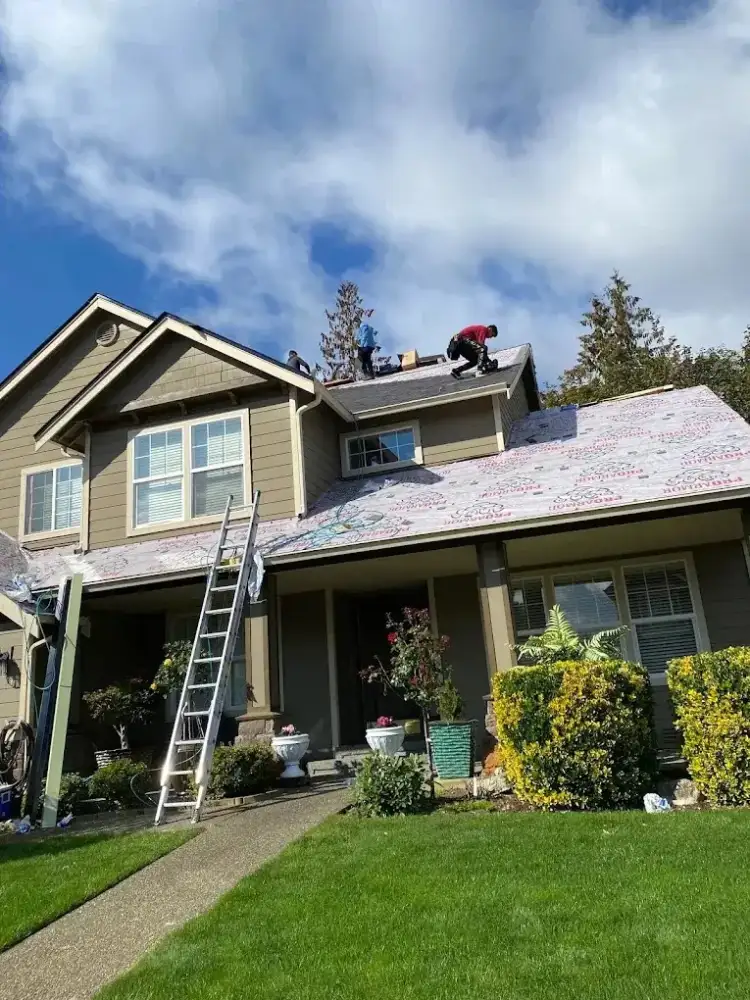
Spot repair
A spot repair fixes one identifiable problem: a few wind-lifted or missing shingles, a cracked pipe boot, failed flashing at a chimney or skylight, or a single leak with a clear source. Done properly, with materials that match the existing roof and the flashing rebuilt rather than caulked over, a repair restores that part of the roof and lets the rest keep doing its job.
The risk is using repairs to postpone a decision the roof has already made. If shingles are curling across whole slopes, granules are piling up in the gutters, or leaks keep showing up in new places, each repair treats one symptom of a roof that's worn out overall. Our repair or replacement guide covers those warning signs in more detail.
What a good repair visit includes
- Finding the actual source. Water travels before it shows up on a ceiling, so the stain is rarely directly under the hole.
- Photos of the problem and the fix, so you can see what was done.
- An honest read on the rest of the roof, including how much life it has left.
Sometimes the honest answer is that nothing needs fixing yet. After an inspection, Joyce Chen wrote that Sean "gave me honest advice that no repair is needed at this time—just keep an eye on it" (read her review).
Verdict: the right first move for isolated damage on a roof with real life left.
Section or partial replacement
A partial replacement tears off and rebuilds one section of the roof, often a single slope that took the worst of a windstorm or sat under a tree that kept it wet. The damaged area gets new decking where needed, new underlayment and new shingles, while the rest of the roof stays as it is.
It can be a sensible middle path, with trade-offs worth knowing before you agree to one:
- Color and texture won't match. Even the same product line looks different from shingles that have weathered for years. On a slope visible from the street, the patch shows.
- Discontinued shingles. If your shingle is no longer made, the new section will be the closest available product, not an exact match.
- Tie-in seams. Where new meets old is a detail that has to be done carefully, or it becomes the next leak.
- Two roofs on one house. The old sections keep aging on their original schedule, so you may be back for the rest sooner than you'd like.
Ask any contractor how the partial job affects your shingle manufacturer's coverage and how the tie-in will be flashed.
Verdict: worth considering when one slope is badly damaged and the rest of the roof is clearly sound. If the whole roof is aging, it's usually money spent twice.
Overlay (roof-over)
An overlay, also called a roof-over or recover, puts a new layer of shingles directly over the existing one. It skips the tear-off, which means less labor, less disposal and less noise. That's the whole appeal, and it's a real one when budget is tight.
Codes limit when it's allowed. The International Residential Code (section R908.3.1.1), which Washington adopts through its state building code, doesn't permit a recover over a roof that is water-soaked or deteriorated, or over a roof that already has two or more layers. Your local building department has the final word on permits for your address.
Even where it's allowed, an overlay has costs that show up later:
- Nobody sees the deck. In a wet climate, soft sheathing at the eaves and around chimneys is common on older roofs. An overlay covers it up.
- The new layer ages faster. Shingles over shingles run hotter, and they follow every wave and curl of the old layer.
- Leaks are harder to trace. Water can travel between layers before it shows up inside.
- The bill comes back. When the overlay wears out, both layers come off in one heavier tear-off.
Our roof-over vs. tear-off guide goes deeper on when an overlay is legitimate.
Verdict: defensible only with a single flat-lying layer, a deck known to be sound and a short ownership horizon. Otherwise, the savings tend to be borrowed from later.
Full tear-off replacement
A full replacement strips the roof down to the deck. That tear-off is the most valuable part of the job, because it is the only time anyone gets to see the sheathing. Soft or rotted decking gets replaced, then new underlayment, flashing, ventilation details and shingles go on as one system. Most residential replacements we do take 1–3 days.
It costs the most up front of anything on this page, and it's the most disruptive: noise, a dumpster or trailer in the driveway, and crews around the house. A careful crew protects landscaping, uses magnets to sweep for nails, and leaves the property clean. Deck repairs are the one cost that can't be priced exactly until the old roof is off, so ask how they'll be handled before work starts.
What you get for the spend
- A known deck instead of a guess.
- New flashing at every wall, chimney, skylight and vent, not old metal reused under new shingles.
- A chance to fix ventilation, which affects how long shingles last.
- The cleanest story for buyers and insurers: one layer, documented, with a known install date.
If 2027 is the year, our 2027 roof replacement timeline walks through when to get inspections and estimates and how to schedule around the weather. More on the service itself is on our roof replacement page.
Verdict: the right answer for a roof near the end of its life, and the only option that resolves what's under the shingles.
Maintenance only for now
Sometimes the right move is to do very little: keep the roof clean, keep the gutters flowing, fix nothing that isn't broken, and plan. This fits a roof that is aging but still keeping water out, where the replacement is already on the calendar and the money is being set aside.
Maintenance in this window means:
- Clearing moss and debris so water drains off the roof instead of sitting on it.
- Keeping gutters and downspouts open through the wet season.
- Watching the attic and ceilings after heavy rain, and acting quickly on stains.
- Fixing anything that actively leaks, even on a roof you plan to replace.
The danger is drift. A plan to "wait a year" can quietly become three, and a small leak left for a wet season can turn a straightforward replacement into one with deck and interior repairs. If you're waiting, set a date, and have the roof inspected before each wet season so you know it's still holding.
Use the waiting period well. Get the inspection and written estimates early, so you're comparing options calmly instead of in the middle of a leak. Decide on shingle style and color, any skylight or ventilation changes, and gutter work while there's time to think. Then the replacement becomes a scheduled project rather than an emergency.
Verdict: a reasonable bridge to a planned replacement. Not a long-term strategy for a roof that's showing its age.
Why the decking decides so much
Most of the trade-offs on this page come back to one question: what condition is the deck in? Shingles are the visible layer, but the plywood or plank sheathing under them is what holds the fasteners and carries the load. In the Puget Sound, the usual enemies are long wet seasons, clogged gutters backing water up at the eaves, and poor attic ventilation trapping moisture from inside.
A spot repair touches a small patch of deck. A partial replacement exposes one section. An overlay covers the whole deck without seeing it. Only a full tear-off lets someone walk the entire sheathing and replace what's soft. That's why the same roof can be a good overlay candidate in a dry climate and a poor one here.
Signs that point to deck trouble include a sagging or wavy roofline, soft spots underfoot, stained attic sheathing and repeated leaks near the eaves. If you see any of those, raise them with whoever inspects the roof, and ask for photos from the attic as well as the roof surface.
How to choose between repair, overlay and replacement
Work through these questions in order.
- How old is the roof, and how does it look overall? Wear across every slope points toward replacement. One damaged area on a healthy roof points toward repair.
- How many leaks are there? One leak with a clear source is a repair. Leaks in several places usually mean the system is done.
- What's the deck like? Sagging, soft spots or attic staining rule out an overlay.
- How long will you own the home? A short horizon can justify a repair or an overlay; a long one usually favors a full replacement.
- Are you selling soon? Buyers' inspectors note roof age, layers and patches, so think about how each option will read on a report.
Questions to ask on any estimate
- What exactly is included? Tear-off or overlay, underlayment type, new flashing or reused, ventilation changes and cleanup should all be spelled out.
- How are deck repairs handled? Ask how soft decking will be priced and how you'll be told about it before it's replaced.
- Will I see photos? Pictures of the problem, the deck and the finished work are your record for buyers, insurers and your own files.
- What happens if it rains mid-job? In this climate, the plan for keeping an open roof dry matters.
- Who is doing the work? Ask whether the crew is employed by the company you're hiring.
Comparing estimates line by line on these points tells you more than comparing the bottom number alone.
First Choice Roof Service is based in Redmond, has worked on roofs across the Greater Puget Sound for 17+ years and is licensed, bonded and insured in Washington. Inspections and written estimates are free, and inspections are photo-documented, so you can see the roof's condition for yourself before choosing. Learn more about our roof repair service, or call (425) 270-1525 to schedule.