
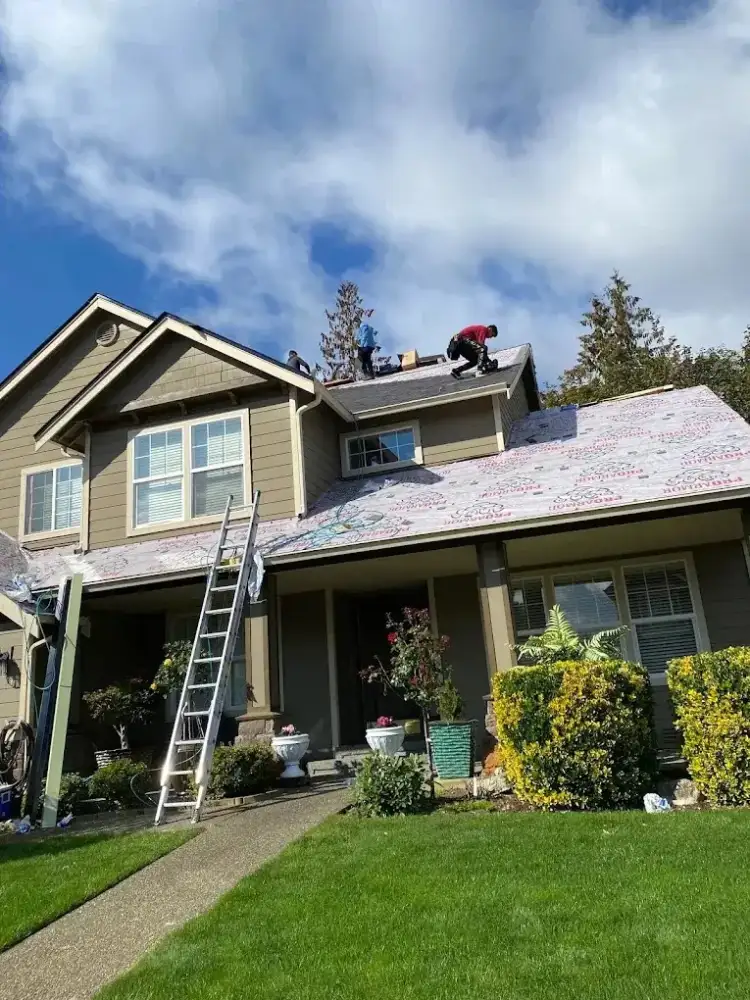
Short answer: treat each roof as its own project with its own inspection, written scope and contingency, then sequence the jobs so the roof with the most risk goes first and the second job benefits from what you learn on the first. If any of the buildings are rented, Washington's Residential Landlord-Tenant Act sets the ground rules: the landlord has to keep the roof in reasonably good repair, and tenants are owed written notice before anyone enters their unit. Everything else is planning: weather windows, communication and paperwork.
What one customer's two-property re-roof shows
Trish Evans reviewed First Choice after the company finished re-roofing "two of our properties." She was candid about the more recent one: "The recent project was completed over four days and presented more significant challenges than we had originally foreseen." Her review doesn't say what those challenges were or how the properties are used, so we won't guess. You can read her full review and see her photos.
What her experience illustrates is the core of this guide: the second roof is never a carbon copy of the first. Different ages, different pitches, different histories under the shingles. Most residential replacements take one to three days (here's what affects how long a roof replacement takes), but a roof that hides surprises can run longer, and owners juggling more than one building feel that more than anyone. She also credited Shaun with patience in "addressing questions and doubts," which is the other half of a multi-property job. You will have questions, and you need a contractor who answers them.
Step 1: Get every roof inspected before you plan anything
Don't schedule from the street. Have each property inspected on its own visit, and ask for photos of what the inspector saw: soft spots, flashing condition, ventilation, signs of past leaks in the attic. A photo-documented inspection gives you something to compare across properties now and something to file later.
For each building, get answers to the same short list:
- How many layers of roofing are on it now, and does the old roofing need to come off? Our post on roof-over vs. tear-off explains why the answer matters.
- Are there active leaks, ceiling stains, or decking that feels soft underfoot?
- What comes through the roof (skylights, chimneys, vent pipes, satellite mounts), and what shape is the flashing around each one in?
- Is attic ventilation adequate, or should intake and exhaust be corrected during the re-roof?
- Is the property governed by an HOA, or part of a condo or townhome association that may own the roof?
Step 2: Decide the order
With two or more roofs, sequencing matters almost as much as price. A few rules of thumb hold up well:
- Worst roof first. A roof with an active leak, or one already causing interior damage, goes to the front of the line. Water damage gets more expensive the longer it runs.
- Use vacancies. If one unit is between tenants, that gap is the easiest time to re-roof it: no entry notices to coordinate, nobody working from home under the noise, easy attic access. A vacancy can be worth moving the whole schedule for.
- Give the harder job the better weather. Roofers in Western Washington work through most of the year, but the drier stretch from late spring into early fall gives the most margin. Put the more complex roof (steeper, more penetrations, older decking) in the driest window. Our guide to the best time of year to replace a roof in Washington covers the tradeoffs.
- Let the first job teach the second. If the properties are similar in age and construction, the first tear-off tells you a lot about what's likely under the second roof. Leave a little room between jobs so you can adjust the scope and budget.
- Back-to-back can work. If both roofs are straightforward, running them consecutively with one crew keeps materials, staging and communication simple. Just don't let the second job's start date pressure the first job into rushing.
Step 3: Budget for what nobody can see yet
The biggest source of surprise on any re-roof is the roof deck: the plywood, OSB or board sheathing the shingles are nailed to. Nobody can fully see it until the old roofing comes off. Rot around a long-leaking skylight, delaminated plywood along a poorly vented eave, or spaced boards left over from an old cedar roof can all turn up during tear-off.
You can't remove that uncertainty, but you can budget for it honestly:
- Ask every bidder how deck repairs are priced. A good written estimate states a unit price for replacing damaged sheathing, so you know what a surprise costs before it happens.
- Ask what triggers a change order and how you'll be told. Photos of damaged decking before it's replaced should be standard, especially if you can't be on site.
- Carry a separate contingency for each property, sized to its age and condition. An older roof with a history of leaks deserves a bigger cushion than a newer one that's simply worn out.
- Know your conversion risk. Older homes that once had cedar shakes often still have spaced boards under the current roof. Composition shingles need a solid deck, so converting usually means adding sheathing. That's a manageable cost when it's identified up front and a painful one when it isn't.
- Don't spend the second roof's cushion on the first. Hold the contingencies separately until both jobs are done.
Step 4: Tenant communication and notice
If a property is rented in Washington, two sections of the Residential Landlord-Tenant Act (chapter 59.18 RCW) matter most during a re-roof.
The duty to repair. Under RCW 59.18.060, a landlord must keep the premises fit for human habitation, including keeping "the roofs, floors, walls, chimneys" and other structural components in reasonably good repair, and keeping the dwelling unit "in reasonably weathertight condition." A failing roof on a rental isn't only a capital-planning question; it's part of the landlord's ongoing obligations.
Notice before entry. Under RCW 59.18.150, except in an emergency or where it's impracticable, a landlord must give the tenant at least two days' written notice before entering the unit, and may enter only at reasonable times. The notice has to state the date and exact time of entry, or a window with the earliest and latest possible times, plus a phone number the tenant can use to object or ask to reschedule. Tenants, for their part, can't unreasonably withhold consent to entry for necessary repairs.
Most roofing happens outside, but a re-roof often involves someone coming in: to check the attic, look at a ceiling stain, or confirm a leak is fixed. Build those visits into your notice. And even on exterior-only days, tell tenants early. A good tenant notice covers:
- The work dates, with a note that weather can move them.
- Working hours and what to expect: noise, vibration, crews on ladders and a debris container on site.
- What to move: cars out of the driveway, patio furniture and grills away from the eaves, anything stored right under the roof edge.
- Attic storage: tear-off can shake dust and small debris loose in an attic, so suggest covering anything stored up there.
- Pets and kids: keep them inside or well away from the work zone.
- Who to call with questions during the job: you or your property manager, not the crew on the roof.
You can read chapter 59.18 in full on the Washington State Legislature's RCW site. This is general information, not legal advice; talk to an attorney about your specific lease and situation.
Step 5: Keep every unit weathertight during the work
The weathertight duty doesn't pause because a project is underway, and on any occupied home a wet attic is the last thing you want. The job plan should make it impossible for a large section of roof to sit open overnight.
- Tear off only what can be dried in the same day. Ask the contractor to commit to that in writing.
- Underlayment goes down as soon as the decking is sound, so the roof is protected even before the shingles go on.
- Watch the forecast together. Agree in advance on who makes the call to delay if heavy rain or wind is coming.
- Have a tarping plan for surprises. A section that needed more decking work than expected shouldn't be left exposed.
- Check the interior after the first real rain once the job is complete, or ask tenants to report any new stain right away.
If you can't be on site each day, much of the planning in our guide to replacing a roof when you can't be home applies to multi-property owners too.
Step 6: HOA and association approvals
If any of the properties sit in an HOA, read the covenants (CC&Rs) and architectural guidelines before you sign a contract. Many associations require approval for changes to shingle color, material or profile, and some approve only specific product lines. Get the approval in writing, and give the contractor a copy so materials are ordered to match.
Condominiums and some townhome communities are different again: the association may own or maintain the roof, or split responsibility with owners. Read the declaration before you assume the roof is yours to replace, or yours to pay for.
Step 7: Keep records that hold up for insurance and resale
With several properties, paperwork is where details get lost. Make one folder per property and keep:
- The signed contract and written scope, plus any change orders with their photos.
- Before, during and after photos, especially of decking repairs, flashing and ventilation work that will be hidden once the job is done.
- Permit records and the final inspection sign-off, if your city required a permit.
- Product details: shingle manufacturer, product line and color, underlayment type, and any manufacturer warranty registration.
- The contractor's workmanship warranty terms, in writing.
- Invoices, proof of payment and any lien releases.
- Copies of the tenant notices you sent, with dates.
These records answer the questions an insurer asks after a storm claim (how old is the roof, what was installed, was it maintained?) and the ones a buyer's inspector asks at sale time. They also make the next re-roof far easier for whoever owns the building by then.
One contractor or several?
There's no single right answer, but the tradeoff usually plays out like this.
Reasons to use one contractor for every property
- One point of contact, one standard of work and one style of documentation.
- Lessons from the first roof carry straight into the second.
- Scheduling is simpler: one calendar to sequence around vacancies and weather.
- If something goes wrong later, there's no finger-pointing between companies.
Reasons to split the work
- The properties are far apart, or one needs a different roof system, such as a low-slope or commercial roof.
- You need both jobs done in the same short window and one company can't staff both.
- You want to see a new contractor's work on a smaller job before trusting them with a bigger one.
Either way, get a separate written estimate for each property, even from the same company, because a single bundled number can hide a lot. Compare scope line by line (tear-off, decking, underlayment, flashing, ventilation, cleanup) and look up every contractor's registration, bond and insurance with Washington's Department of Labor & Industries. Our checklist for choosing a roofing contractor in Washington walks through the questions to ask.
A multi-property planning checklist
- Inspect every roof, with photos, before setting a schedule.
- Rank the roofs by risk: active leaks and occupied units first, vacancies as opportunities.
- Get a separate written estimate for each property, with deck-repair pricing spelled out.
- Set a contingency for each property and hold it until every job is done.
- Confirm HOA or association approvals in writing.
- Send tenants written notice that meets RCW 59.18.150 for any entry into a unit.
- Agree on a same-day dry-in rule and a weather plan.
- Collect photos, product details, warranty terms and invoices into one folder per property.
Talk it through before you commit
First Choice Roof Service is based in Redmond, is licensed, bonded and insured in Washington, and has been in business for 17+ years serving the Greater Puget Sound area. If you're planning more than one roof, a free, photo-documented inspection of each is a sensible first step. See how our roof replacement process works, then request a free estimate or call (425) 270-1525.